
EcoFlow Backup Power: Size Your Loads First
Use a watts, surge and hours worksheet to size household backup power, then decide whether EcoFlow DELTA 3 Classic fits your outage plan.
By Randall R. Russell, USMC Veteran
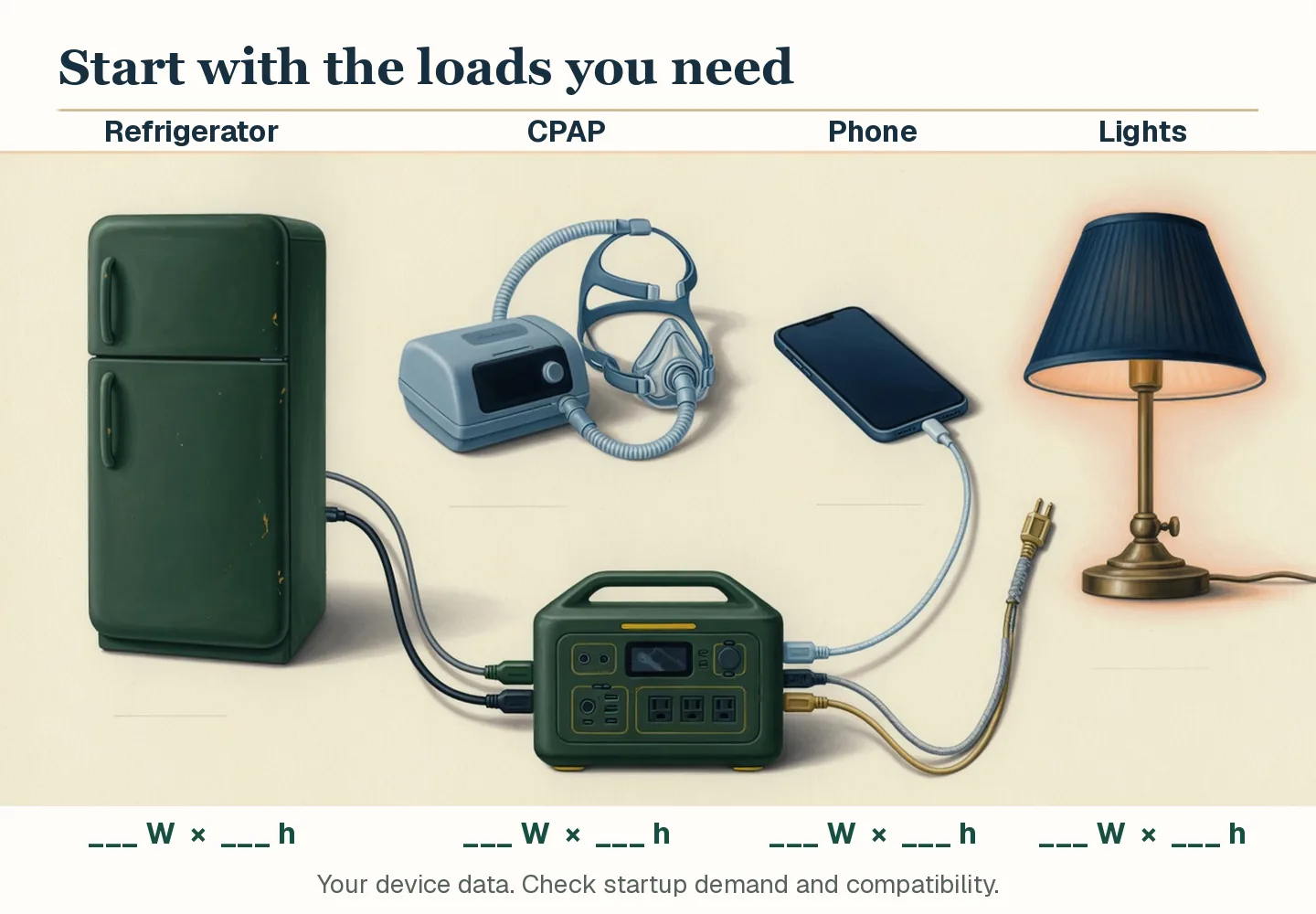
Illustration: enter your own device watts and operating hours. No appliance ratings, runtime or medical-device compatibility are claimed.
Buy for the appliances you need, not the largest number on the box. First total their watt-hours for your planned outage window. Then check running watts, startup surge and how you will recharge. EcoFlow's DELTA 3 Classic is worth considering only after those numbers fit. For phones and a few lights, you may not need a power station at all.
Catalog-only coverage: Fortified Living has not tested this power station, measured its runtime or verified it with your appliances. Product details below come from EcoFlow's US sources, checked October 13, 2026.
What Do You Actually Need to Keep Running?
Write a short essentials list. A router, phone charging and two lamps are a different purchase from refrigeration and a well pump. Leave convenience appliances off the first pass.
If you already have an outage plan, use our loads-first power-station sizing guide alongside this worksheet. This article takes that approach through one specific EcoFlow buying decision.
For the broader planning overview, read solar generators for off-grid power.
A watt measures power at a moment. A watt-hour measures energy used over time. Virginia Cooperative Extension explains the calculation and why appliance settings affect consumption: watts multiplied by operating hours gives watt-hours. Divide by 1,000 for kilowatt-hours. [1]
Fill In Your Watts, Surge and Hours Worksheet
Use your device manual, nameplate and measurements where available. Record where each number came from. A charger's maximum rating is not proof that it draws that much throughout charging.
| Essential Device | Running Watts | Startup Surge Watts and Duration, If Applicable | Operating Hours in Your Outage Window | Energy: Watts x Hours | Source of Number |
|---|---|---|---|---|---|
| Router and modem | ____ | ____ | ____ | ____ Wh | ____ |
| Lights, combined | ____ | ____ | ____ | ____ Wh | ____ |
| Phone charging, combined | ____ | ____ | ____ | ____ Wh | ____ |
| Refrigerator or freezer | ____ | ____ | ____ | ____ Wh | ____ |
| Other essential: ____ | ____ | ____ | ____ | ____ Wh | ____ |
| Total energy | ____ Wh |
Outage window: ____ hours. Running watts with devices operating together: ____ W. Largest expected startup demand, including other devices already running: ____ W for ____ seconds. Confirm the startup requirement with the appliance maker if it is unknown. Unknown is not zero.
For cycling appliances, use measured energy over a representative period when possible. A refrigerator being plugged in for 24 hours does not mean its compressor runs for 24 hours. Door openings and conditions change the result; don't substitute a generic fridge runtime promise for your own information. [1]
A Small Example, Not an Appliance-Runtime Claim
These are invented planning inputs to show the arithmetic, not typical ratings, measured household data or EcoFlow test results. The hours cover one chosen outage window.
| Hypothetical Load | Assumed Watts | Assumed Operating Hours | Calculated Energy |
|---|---|---|---|
| Router and modem | 12 W | 10 | 120 Wh |
| Two lights, combined | 10 W | 5 | 50 Wh |
| Phone charging, combined | 10 W | 3 | 30 Wh |
| Total | 200 Wh |
If all three run together, their assumed running demand is 32 W. Startup requirements still need their own check.
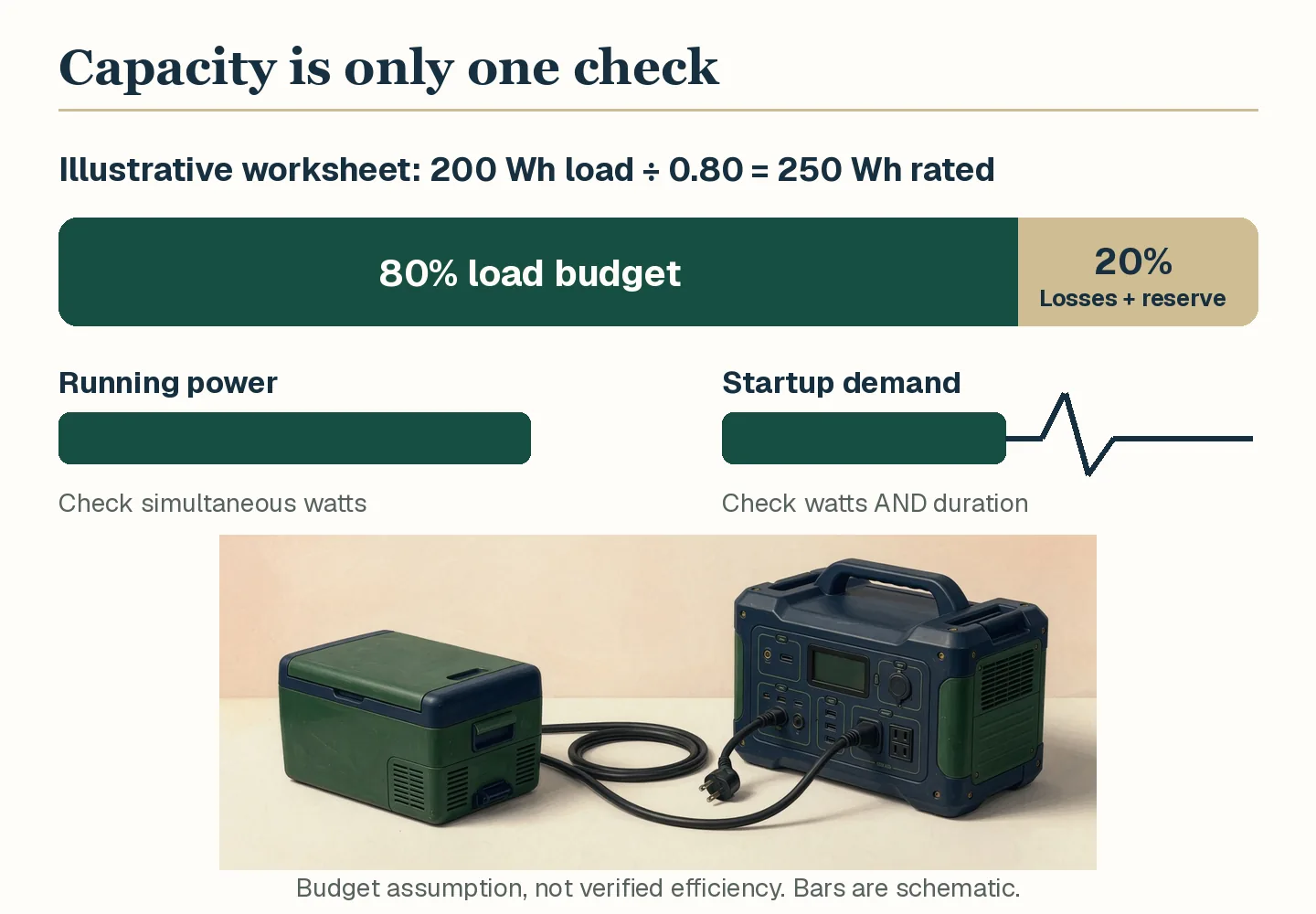
Now leave room between the battery's nameplate capacity and what you plan to use. For illustration only, suppose you budget 80% of rated capacity for your loads, leaving 20% for losses and reserve. That is a worksheet assumption, not a verified EcoFlow efficiency or a guarantee. Conversion losses, idle consumption, settings and conditions change usable energy.
Under that assumption: 200 Wh / 0.80 = 250 Wh of rated capacity. A 1,024 Wh station would be more battery than this particular plan calls for. Compare what you already own before paying for the extra capacity.
By contrast, a hypothetical 900 Wh plan needs 1,125 Wh of rated capacity under the same assumption. A 1,024 Wh unit would not meet that plan without reducing loads or adding verified replenishment. Buying it on sale would not fix the shortfall.
Does the EcoFlow DELTA 3 Classic Fit Your Numbers?
The candidate here is the US EcoFlow DELTA 3 Classic Portable Power Station (1024Wh), base-unit SKU EFDELTA3C-US-L, merchant variant 54691871227977. It is not DELTA 2, DELTA 3 Plus, the grey variant or a solar bundle. EcoFlow lists those separately. [2][3]
| Manufacturer-Listed Detail | What You Need to Check |
|---|---|
| 1,024 Wh rated capacity | Your planned energy use fits with an allowance for losses and reserve, not just the nameplate number. |
| 1,800 W total AC output, 120 V / 60 Hz | Your simultaneous AC loads stay within the total rating, not 1,800 W per outlet. |
| 3,600 W surge output | Your appliance's startup watts and required duration are compatible. A peak number alone does not establish that. |
| LFP battery chemistry | This is the chemistry EcoFlow lists, not a claim of unlimited life. |
| 500 W maximum solar input | This is an input limit, not energy production or a daily recharge guarantee. |
Specifications are manufacturer claims, not our test results. EcoFlow also advertises X-Boost, but this worksheet uses the normal AC rating. Do not count a boosted headline as ordinary continuous output or confirmed appliance compatibility. [2]
The base unit is a reasonable catalog candidate when your measured essential loads pass both the energy and output checks and you have a workable charging plan. It is the wrong fit when the numbers do not close, your appliance needs a different voltage, or you need reliable power for longer than your stored energy and recharge plan support.
Do not buy it as a whole-house promise. This worksheet covers individually connected appliances, not instructions for connecting equipment to house wiring. Have a qualified electrician assess any building-circuit plan.
Our Picks: Buy the Capacity Your Plan Needs
| Choice | Fits Best When | Main Downside |
|---|---|---|
| Power banks, rechargeable lights and equipment you already own | Your needs are compatible small electronics and lighting. | Does not solve an AC-appliance requirement; check device and charging compatibility. |
| EcoFlow DELTA 3 Classic base unit | Your worksheet fits its listed capacity, voltage and output with reserve. | Rated capacity is not delivered energy; it may be too much for small loads and too little for a larger outage plan. |
| More storage or a different backup-power design | Your energy, voltage or startup requirement exceeds this model. | More cost and planning; more storage still needs replenishment for a prolonged outage. |
For a broader comparison, use our family-scale backup-power buyer's guide. Compare the current exact models and their limits rather than assuming every unit in a capacity class behaves alike.
If the DELTA 3 Classic fits your completed worksheet, check the EcoFlow DELTA 3 Classic's current options. Select the base SKU above unless you deliberately choose and separately check a bundle. The existing shopping route opens EcoFlow's product family page, not a locked cart variant.
What About the Sale and Recharging?
EcoFlow's US Prime Day Fall Extended Sale terms list an end of October 18, 2026, at 11:59 PM PDT. The promotion is for eligible US residents with a valid continental-US shipping address. Offers have product exclusions and combination restrictions. Check the current terms for the exact selection before paying. [4]
No price, percentage saving, coupon or free gift is promised here. This is the merchant's stated sale window, not a reason to buy a unit that fails your worksheet. Individual offers can have different conditions. If you are reading after that date, do not treat the promotion as current.
Before buying panels, write down how much energy you need to replace each day. Check the exact panel's electrical compatibility and the station's input requirements. A panel's rated watts are not watt-hours delivered into the battery. Shade, weather and daylight affect the plan; do not assume the maximum solar input is available all day. Our Off-Grid Blueprint planning hub connects the power decision to your wider household plan.
Count the Cost Before You Buy
Jesus speaks here about the cost of discipleship. This is not a product endorsement. For this purchase, the practical discipline is simple: sit down, do the numbers and keep the household budget intact. Preparation should serve the people in your home, not a sale deadline.
What to Do First
- Choose your outage window and list only essential devices.
- Fill in running watts, startup demand, operating hours and total watt-hours. Resolve missing appliance information.
- Compare capacity with your reserve assumption, then check voltage, continuous output and surge compatibility.
- Write a replenishment plan. If the plan does not close, reduce loads or compare another solution.
- If this exact model fits, check the current EcoFlow DELTA 3 Classic offer and terms. If it does not, keep your money and finish the plan.
Sources
Last reviewed: October 13, 2026. Product specifications and merchant sale terms checked on that date. Worksheet examples are Fortified Living's illustrative calculations, not product testing.
- Virginia Cooperative Extension: Estimating Appliance and Home Electronic Energy Use, February 26, 2020. Watts, operating hours, nameplates, cycling appliances and startup demand. Credit: Virginia Cooperative Extension, Virginia Tech and Virginia State University.
- EcoFlow US: DELTA 3 Classic product page and specifications. Rated capacity, chemistry, normal AC output, surge, maximum solar input and distinct bundle selections. Manufacturer source, not an independent test.
- EcoFlow US: DELTA 3 Classic product variant data. Base SKU EFDELTA3C-US-L and variant 54691871227977; inventory observation is not a stock guarantee.
- EcoFlow US: Prime Day Fall Extended Sale terms. Stated US promotion ends October 18, 2026, 11:59 PM PDT; eligibility, exclusions and offer-combination restrictions apply.
- Luke 14:28, King James Version. Full verse copied from Fortified Living's pinned KJV dataset.
Products in this article
Fortified Living
Randall & Robbie Russell · USMC Veteran + retired RN