
Power Outage Family Plan: Before, During and After the Lights Go Out
Write your family's power outage plan: what needs power, food-safety times, carbon monoxide rules, and a simple sheet to size a battery power station.
By Randall R. Russell, USMC Veteran
Health note: This is general information, not medical advice. Follow product labels and your doctor or pharmacist.
Many families have never written down what they will do when the power drops. You know where the flashlight is, mostly. You think the freezer will be fine, probably. This page turns that into a plan you can print and put on the fridge.
Work through it in one evening or over four weeks. Pencil is fine. The free printable at the bottom has every worksheet with lines to write on.
Step 1: What in Your House Runs on Power?
Ready.gov says to start with an inventory of everything you need that relies on electricity, then plan batteries or another power source for each one. It also says to have a flashlight for every person in the house and to find out whether your home phone works without power, and for how long.
Walk the house once with a notepad. Write down each thing, why it matters, and what you will do without it.
| What needs power | Why it matters | Our backup plan |
|---|---|---|
| Refrigerator and freezer | Food for the week | Keep doors shut, cooler and ice ready, thermometer inside |
| Phones | Calls, alerts, news | Power bank and car charger |
| Lights | Safety after dark | One flashlight or headlamp per person |
| Well pump, sump pump, garage door | Water, flooding, getting the car out | Stored water, know the garage door manual release |
| Your item here |
Quick Checks
- ☐ One flashlight for every person
- ☐ I know whether our home phone works without power
- ☐ Battery-backup carbon monoxide alarm on every level
- ☐ Smoke alarms tested this month
- ☐ Appliance thermometer in the fridge and the freezer
- ☐ Two weeks of food and water on hand
- ☐ Car gas tank at least half full
- ☐ Signed up for local outage and weather alerts
The Red Cross says to store non-perishable food and water for at least two weeks and to put a carbon monoxide alarm on each level of your home. The CDC says to keep appliance thermometers in the fridge and freezer. Not sure where to start on food? Our 72-Hour Emergency Food Supply guide covers the first three days.
Step 2: Medicine, Devices and Your Support Network
Your Support Network
The Red Cross says to identify people who can help you stay at home or leave during a long outage, and to keep a paper copy of your contact list. Pick two or three people. Write down what each one can help with: a ride, a place to stay, a check-in call, a spot to charge phones. Then print it. A phone list on a dead phone does not help anyone.
Step 3: During the Outage, Stay Safe and Keep Food Cold
Carbon Monoxide: the One That Kills Without Warning
- Never run a generator, camp stove or charcoal grill inside the house, garage, basement or crawlspace, even with the doors open.
- Run a generator outside only, more than 20 feet from windows, doors and vents.
- Never heat the house with a gas stove or oven. Ready.gov says it raises your risk of carbon monoxide poisoning and of fires and burns.
- If the carbon monoxide alarm sounds, get everyone outside right away. Then call 911.
- Never plug a generator into a wall outlet. Only an electrician should install a transfer switch.
A battery power station is different. It has no engine and burns no fuel, so it makes no exhaust the way a gas generator does. Our Family-Scale Backup Power guide explains how one works in plain terms.
Keep the Food Cold
- Keep the fridge and freezer doors closed. The CDC says that with the doors shut, food stays safe up to 4 hours in a refrigerator, 48 hours in a full freezer and 24 hours in a half-full freezer.
- At the 4-hour mark, if you have a cooler and ice, move refrigerated perishables into it and keep them at 40°F or below.
- Unplug appliances and electronics so a surge does not damage them when the power comes back.
- Use flashlights, not candles.
- If the house is too hot or too cold, go to a place with power. Check with local officials for warming or cooling centers.
Write the time the power went out on the printable's outage log. Add 4 hours for the fridge and 48 or 24 for the freezer. Now nobody has to remember at 2 a.m.
Step 4: After the Power Comes Back
- When in doubt, throw it out. Never taste food to test it. The CDC says to throw out perishable food from the refrigerator after 4 hours without power or a cold source, and anything with an unusual smell, color or texture.
- Thawed frozen food that still has ice crystals, or is at 40°F or below, can be refrozen or cooked.
- Restock what you used: batteries, ice, water, fuel.
- Write down what worked and what you would change. Then set the next review date: once a year, or after any outage.
Step 5: Size Your Backup Power
You only size backup power once you know what you need to run. That is why this step comes last.
- From your Step 1 list, circle only what you truly need to run: lights, phones, a radio, maybe the fridge for part of the day.
- Find each one's watts on its label or in its manual. Write it down.
- Add the watts of everything you would run at the same time. Your station's output rating has to be higher than that total.
- For each item, multiply its watts by the hours you want it to run. That is the watt-hours it needs. Add them up.
- Compare that total to the station's usable watt-hours, not the number on the box.
| Item | Watts (from the label) | Hours a day | Watt-hours (watts × hours) |
|---|---|---|---|
| LED light bulb | ~10 | 5 | 50 |
| Mini fridge | ~100 | 4 | 400 |
| Your item | |||
| Total |
Why usable and not the box number? Batteries lose some power, and it is smart to stop before empty. Our backup power guide uses about 830 usable watt-hours for a 1,070-watt-hour station. For any other station, use the maker's own run-time calculator and keep the difference in mind. Want the full walk-through, with panels? Read how to size a power station by loads and panels or line the models up on our power station comparison.
Limits: a family-size station will not run central air, an electric range or a whole house. Save it for the small jobs that matter most.
Gear for This Plan
One or two picks per item, no more. Paid links are marked. We may earn a commission at no extra cost to you. More picks, with the tradeoffs spelled out, live on our light and communications gear page and backup power gear page.
Light for Every Person
Black Diamond Spot 400 Headlamp (paid link). Hands free beats a flashlight in your teeth when you are checking the breaker box or the freezer. Honest downside: more light than you need if all you want is a backup by the bed.
Black Diamond Astro 300 Headlamp (paid link). The simpler one to put in every bedroom and every kid's drawer.
News and Weather
Midland ER310 (paid link). A NOAA weather radio with a rechargeable battery you can top up by hand crank or solar, with a flashlight built in. Honest downside: it is a radio and a light, not a power station. It will not run the fridge.
Phone Power
Anker Nano Power Bank 10,000 mAh 30W (paid link). Keeps a phone alive, and the cable is built in, so there is nothing to forget. Honest downside: sized for phones and small devices, not a laptop through a long outage. Charge it before storm season.
Backup Power Station
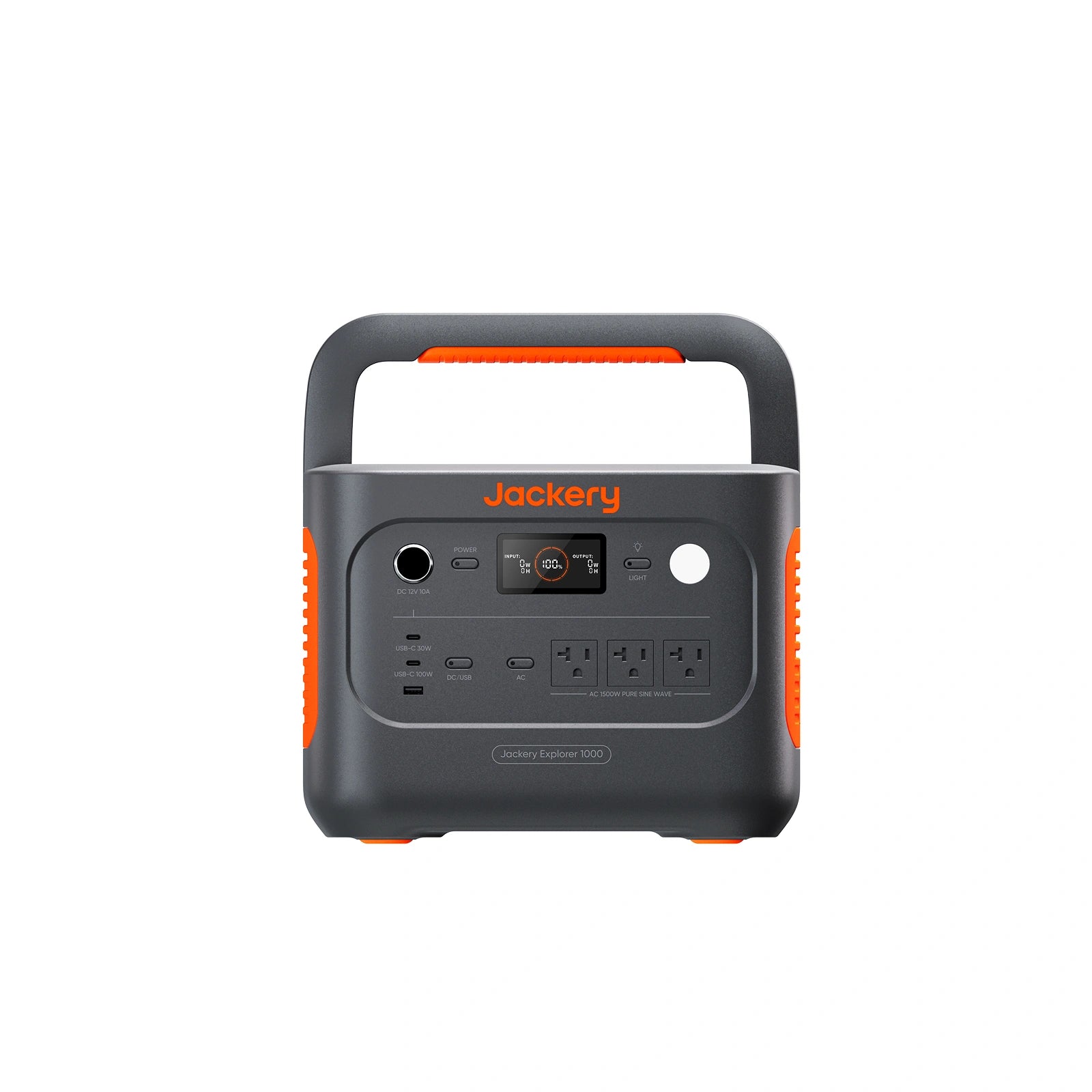
Jackery Explorer 1000 v2 (paid link) holds 1,070 watt-hours and puts out up to 1,500 watts, with a LiFePO4 battery. Honest downsides: it is heavy, so give it one spot. Solar charging takes hours, not minutes. Jackery does not recommend it for medical devices or life-support equipment.
EcoFlow DELTA 3 Classic (1024Wh) (paid link) holds 1,024 watt-hours, also LiFePO4. EcoFlow lists up to 1,800 watts of total AC output. Panels are not included with the base model, so check which version you order.
Still on the List, No Pick Yet
A battery-backup carbon monoxide alarm for each level, an appliance thermometer for the fridge and freezer, and a good cooler. Buy them from any store you trust. We will add picks here once we have ones we are willing to stand behind.
Get the Printable Plan
The free printable has every worksheet from this page with lines to write on: the power inventory, the medicine and device plan, the support network, the outage log and the backup power sizing sheet. Print it, fill it in, and put it where the whole family can find it. When you are ready for the next one, see all of our free printable guides.
Where This Advice Comes From
- Ready.gov: Power Outages
- American Red Cross: Power Outage Safety
- CDC: Carbon Monoxide Poisoning Basics
- CDC: Keep Food Safe After a Disaster or Emergency
- Product details: each maker's own pages (Jackery: Explorer 1000 v2 specifications; EcoFlow: DELTA 3 Classic Portable Power Station (1024Wh); Midland: ER310 Emergency Weather Radio)
Last checked against these sources: October 11, 2026.
Your free printable plan
5 pages with lines to write on. No store links and no prices inside.
Every pick above also sits with our other backup power & solar picks.
See all Backup Power & Solar picks on the Deals page →